The page stops being white
A day spent in layout: a watercolour ground, a closed foot, a gold rule at every threshold. Nothing about the rules.
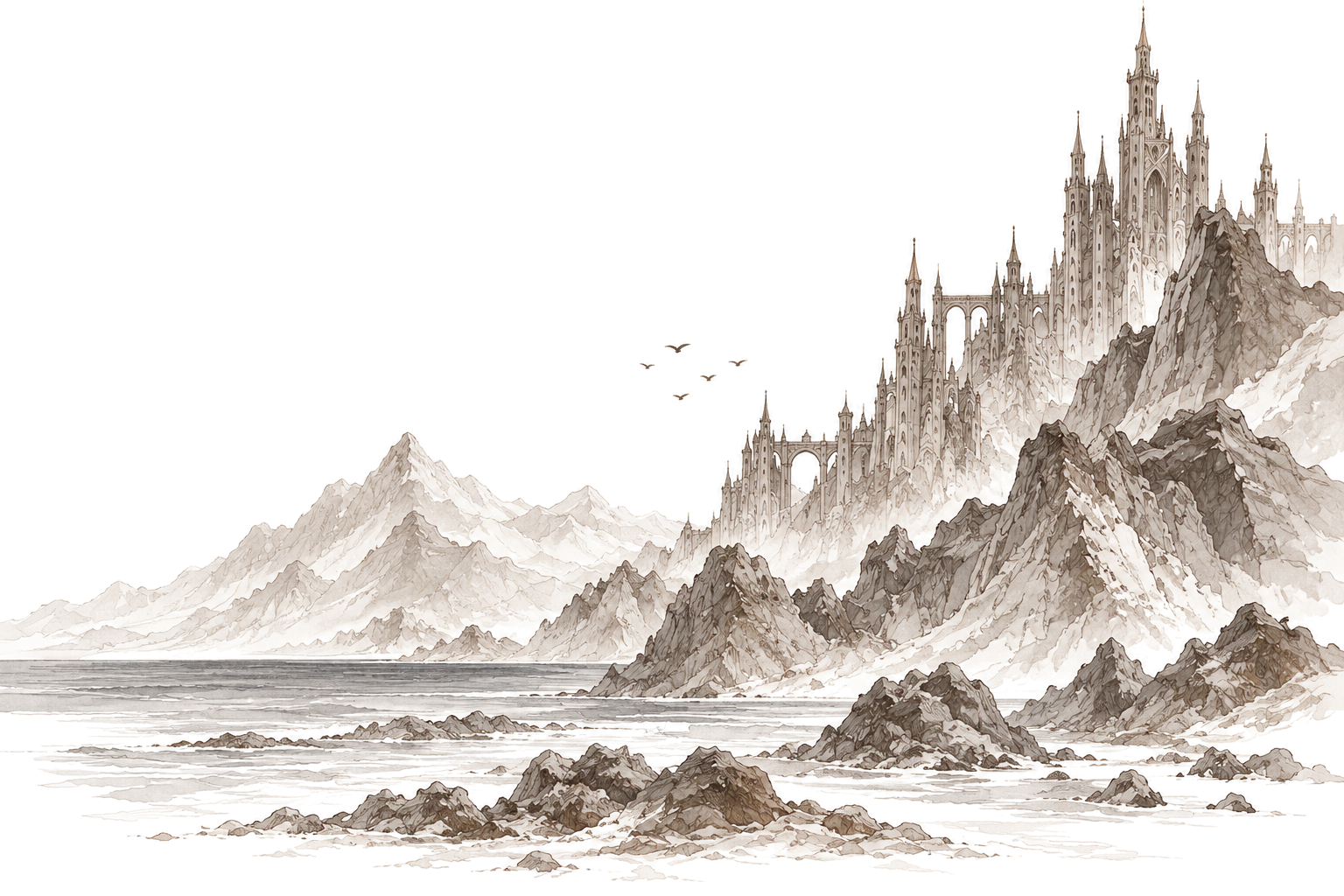
The PDFs spent a day in layout. Not one rule changed — this is entirely about how the book looks on the page.
#FFFFFF is the color of nothing. No sheet of paper is that flat, and a PDF read on a screen shows it more plainly than print does, where the paper brings its own matter along. So every page of both editions now sits on a watercolor wash — grain throughout, faint grey clouds in the corners. You are not meant to look at it. It is there to take the last screen-like quality out of the background.
It does not repeat identically, which matters more than it sounds. The same stain in the same corner across three hundred pages is a watermark, not paper: by the third page your eye recognizes the pattern and stops seeing a sheet. The image turns through its four symmetries as you go, so four pages pass before an arrangement comes back.
What else you will see
Section titled “What else you will see”- The foot of every page closes. A rosette between two rules, sitting above the folio. A grey numeral alone under a column of justified text does not close a page — it just sits there.
- Part Opening (the)the gesture that begins every scene: three cards, you keep one, you give up the other two. The only draw where choosing costs, and the only door of fate.part 3 are on the axis. Title, rule, subtitle and the block of the opening fiction all center under an illustration that has always been centered. Only the text of the fiction stays ranged left: nine lines of centered narrative read like an epitaph.
- The opening wash no longer stops on a hard edge, it fades into the sheet — and the rest-page drawing has been cut out of its white background altogether, so the paper now shows through the drawing instead of stopping at its border.
- Section titles get a gold rule above them. In this book the rule is what says hierarchy — part opening, aside, fiction, exercise — and the section title was the only threshold carrying none. It costs no space: the air above the title was already there, the rule moves into it.
- The running head left the sans-serif. A folio is a landmark you look for; a running head is a phrase you read without looking for it, and a grotesque atop every page of prose says manual above a text that says novel.
- Asides are held by a gold bar down their left flank. A 5% grey panel does not read on paper the way it reads on a backlit screen — it was dissolving, and the aside with it.
- Two part openings had outgrown their page. The ambient fiction of Introduction and The World scenea declared scene in which your character is not present: the world advances behind his back. After three scenes played at his side the floor is the world’s; never two in a row, and fate does not come into it. It moves forward what pends, or it merely lives — a breather.part 9 spilled three or four italic lines onto the next sheet, stranded above a void. They were cut back to fit. The turns that matter — the poison remark, the letter — were not touched.
Still generated, and still ashcan
Section titled “Still generated, and still ashcan”Two things worth saying plainly, because the pages above might suggest otherwise.
This book is still made by a pipeline. Markdown goes in, pandoc and Typst come out the other end, and nobody opens the file to nudge a line by hand. Every adjustment described here is a rule in a template — which is why it applies to every page and to both editions at once, and why the whole volume can be rebuilt in seconds after a cut. That is the strength, and it is also the limit: a pipeline sets a good page everywhere, where a typesetter would set a perfect one here and there.
And these are ashcan embellishments. They are not the final design, any more than the AI images are the final art. They serve the file you download now; the day this book is actually printed, most of them will be reconsidered — starting with the paper texture, since real paper already has its own grain, and printing grain onto grain is just doubling it.
The whole book is free to read online here, in both editions, and the PDFs on itch.io are already the new ones.
Ashcan edition: the book is complete and playable; it is not finished. Tell me what breaks.