Introduction
seeing what it looks like
I walk down the Belle Avenue of Nandésis, the mother city of the Free Lands. Far off the roofs rise in tiers, the lower city, its inland sea, then the sky, a blazing blue, where imposing skygliders drift above the rare clouds.
I come back to my walking. I have been given an errand: a list of ingredients to gather from shop to shop. I dawdle from window to window, past hanging herbs, phials catching the daylight, the smell of hot bread a little further on; and the world goes by and brushes past me, indifferent and alive. The great avenue soon narrows into a quieter alley, cooler, strung with ivy and climbing roses. At the end of it, a small shop lit from within: Ephita, herbalist.
Inside, glass-topped Table (the)the surface in front of you: the cards drawn stay in view on it for the length of the scene.parts 2, 7 hold a multitude of ingredients: roots, flowers, leaves, dried, fresh or still in their soil, arranged by category, by name, by effect, by color. Ephita presides behind her counter and bids me welcome. I hand her the list.
She reads. She stops. “This looks almost like a recipe for… for poisoning someone!”
And what if it were? All at once I am no longer so sure I want to see this errand through.
Welcome, reader. Here you will learn to play roleplaying games alone, with a notebook, a tarot Decka single pack of 78 cards, majors and minors mixed, reshuffled at the opening of every scene.part 2 and a Cointhe oracle of closed questions: heads the first pole, tails the second. It never resolves an action.part 1.
The notebook will be the written support, the memory of the game and its pace. The coin and the tarot will be its oracles, giving a direction or a clear answer. These three tools are enough: you propose, they decide. From that come the choices that cost, the hard failures, the blazing victories.
◆ The notebook
Section titled “◆ The notebook”
The notebook is where the game comes to rest, and often where it is born. It holds two offices.
It is your memory. You keep in it what has to survive the Scenethe unit of play: you open it, you play it, you close it.part 3: your character’s Portraitwhat you write about someone, actor or character: a name, what he wants, his suits, and what he carries when that says who he is. Without any count, and never corrected — you write a fresh one, further on.parts 7, 11 (part 11), and the Standing pagethe page that keeps what is pending: living actors, waits, stakes, desires under way, doors closed by fate. There is only one, and it replaces the previous one.part 8, what is left pending: the Actora presence that wants: someone who will come back and weigh, where the Backdrop is forgotten. You anchor him on the standing page in one line.part 7 the world has raised, the questions left open (part 8). Without it, everything dissolves; with it, a game holds over time.
It is your matter. The scenes in progress are written there as they go, and that writing does not archive, it begets. One sentence set down calls up another; the card falls, you note it, and the fiction moves forward under your pen. It is the notebook that turns a run of draws into a story.
And above all, writing slows you down. This game is not won on speed: it is savored. The hand that traces is the metronome; as long as it moves at its own pace, you stay inside the scene instead of hovering above it. It is that slowness that makes you lose yourself in the play. And what slows you is the hand, not the fine sentence: a phrase that comes is a pleasure; a phrase you hunt is already a way out.
A notebook you love — good paper, a nib that glides — invites the gesture and makes it precious: the object is part of the pleasure. But nothing obliges you. Ask the Sky pushes hard toward the notebook; it does not demand it. A notes app, a piece of software, a voice recorder will do. What counts is not the paper: it is that something hold what has been played, and slow your hand.
◆ Player and Game Master at once
Section titled “◆ Player and Game Master at once”As a solo player, you are both the author and the player, and for the game to surprise you, you must give up part of your authority. The tarot and the coin see to that: the surprise, the roundabout paths. The action and Fatewhat comes in when you keep a major at the opening, and by no other door: the moment stops being ordinary. What it closes, only it can open.part 6, for their part, give the successes and the failures. That is the game’s resistance, without which you would only be inventing a story. Ask the Sky is a roleplaying game played by writing: you interpret, you invent, you write your story. To choose is to renounce — and that is the whole game.
◆ What you play
Section titled “◆ What you play”There is no character sheet, no numbers to spread around, no catalogue of actions to choose yours from. And nothing grows in power: your character will never be stronger than he is today. He will be more committed, which is another thing. No draw consults what he is worth; the world answers what you attempt, not what you are.
What the game does ask of you, it asks on every page: to propose. The two outcomes you hold out to the coin before you flip it, you are the one who invents them. What a card means tonight, nobody will hand you. What you put at Stakean open question on which somebody else is making progress: it does not forget itself, and it does not ripen on its own.parts 8, 10 when fate comes in, what you give up in order to take something else: you again. Chance does not supply the matter. It decides between yours, and it will not be swayed.
So know where you are setting your feet. Anyone who comes looking for a sheet to fill in and a curve that climbs will close this book disappointed, and rightly so. Anyone who loves to write is already at home.
◆ Your matter is the world
Section titled “◆ Your matter is the world”Your store of ideas is the world you play in. A world of your own, or a known setting that you love. When you look for a possible, draw on that world, or if need be on an encyclopedia of that world. And feel what your character Desirewhat your character wants. No mechanism, no count: it orients what you play.part 11: where he wants to go, what he would attempt, what he flees. Desire is your Compass (the bearings)the four suits taken as directions, on the day the page empties: what to turn toward when you no longer know what to do.part 12 when you hesitate.
And if you have no setting in mind, that is not a wall: let the draws reveal the world piece by piece. This game can bring a world into being as readily as explore one.
◆ Sketch your “I”
Section titled “◆ Sketch your “I””Before you draw your first card, give yourself an I, someone through whose eyes you will look at the world. Nothing heavy: a name, a sentence that says who he is, a desire that sets him moving. Three lines in the notebook, and there you are, somebody. This is not the portrait, it is the first sketch: you will play first, you will discover him by making him act. And then, the day the urge comes to set him down for real (his past, the way the Suits (the four)Wands/Fire, what cannot wait · Cups/Water, what comes back · Swords/Air, the line that separates · Pentacles/Earth, what remains. They say a card’s matter, and how you acted.part 4 live in him, what he wants underneath), part 11 is waiting for you. One only knows oneself well after having lived a little.
◆ Watching a scene played: The reunion
Section titled “◆ Watching a scene played: The reunion”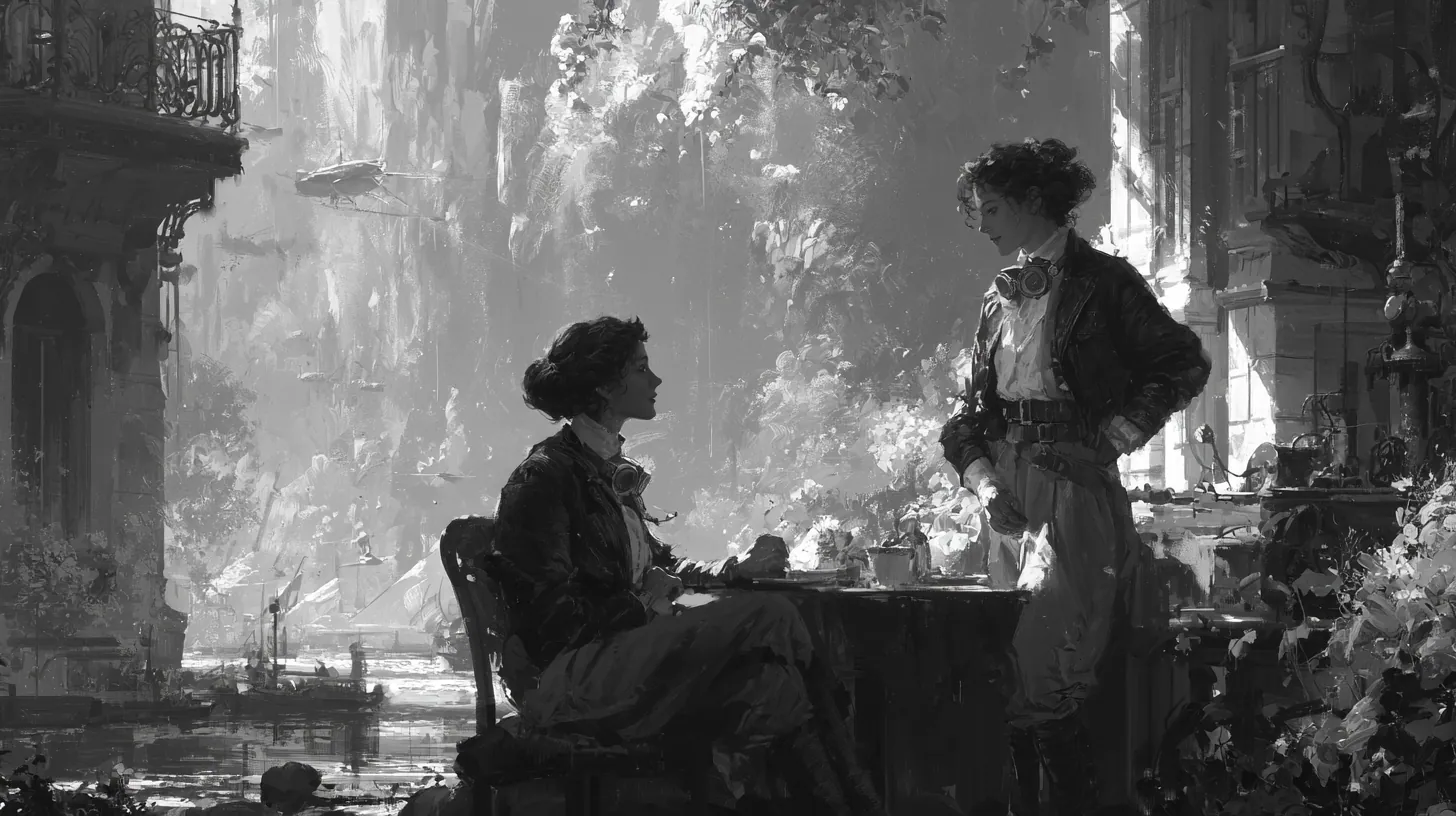
I come into the scene through the opening, three cards laid down before me. A Three of Cups: a happy reunion. A Six of Swords: a passage, a gentle mourning. And, between the two, a major: Justice. I could take a minor and play a tender scene, but it is Justice that is alive. It does not tint the scene, it bends it: accounts will have to be rendered, a defense made, and someone will have to decide. I choose it, I give up the other two — and in taking it, I know that fate comes in. A sentence comes to me:
Late morning, early spring. A café by a canal, in the South of the city. Today I am meeting Sybia, my oldest friend, the one whose bond has held through everything. But something tells me nothing will be light.
I frame:
The sun is already beating down. A table backed against a small canal, in the winding alleys of the South. The water runs with a soothing steadiness.
The card taken, I probe it with the coin: two poles I stretch before I toss. Does she come to me at peace, or already weighed down by what she knows? Heads, she arrives light; tails, she carries a weight. Tails.
I see her coming from inside the room. “Sybia!” — my breath catches. We throw ourselves into each other’s arms. “Nera… I can’t believe we’ve found each other again.” We look at each other properly. Time has passed, the lines have shaped her face, but it is the same gaze, sure and motherly. And beneath the joy, that gravity she does not hide.
Justice is already weighing: the sweetness will not hold.
She looks away. “Nera, I would have wanted good news. You have been struck off from the sisterhood. They are saying things that… even I cannot deny. Glad to see you, and broken to know.”
There are the accounts to be rendered, what Justice was demanding. And what I want, right there, more than anything: for her to believe me, and to clear my name. That is my desire. Fate has come in, and a single question divides it: can I do anything? Yes. I can speak. So I face it.
Facing fate
Section titled “Facing fate”I set the wager before turning a single card, in two clauses: if I carry it, she believes me; if the world carries it, our friendship comes to an end. Under fate, what is lost only fate can open again — I know it as I wager, and I wager all the same.
Then I describe what I attempt. Not a line of dialogue: a movement, in one block.
I put it all down, in no order: what was done to me, what I did. She listens, motionless. Then I hear myself plead, argue, cut, and the more I reason, the deeper I sink; her gaze hardens on what she has already heard elsewhere. So I stop. “Don’t leave like this. Not you.” My voice breaks, and I do not move.
Two cards now: one for me, one for the world. The stronger wins, and on a tie, the world does.
For me comes a major: The Star, bare hope, the way out that did not exist a second before. For the world, the Eight of Pentacles: Earth, the slow work of a reputation, everything they have patiently repeated about me. A major wins over any minor: I carry it. And carrying it with a major is a fate’s flare — the success that overflows what you were attempting.
A memory rises — the canal of our childhood, the vows we made then — and I offer it to her whole. Something gives way in her eyes. Three hours pass. A silence. Then: “Nera, my sister… I am shaken. And glad to have you back for good.”
The flare overflows, and that is just what happens: I only asked to be believed, and I get wider than my question. My desire moves forward by a long stride: clearing my name stops being a dream and becomes a road. My hands are still shaking when she takes me back into her arms: the body lets go of what the will was holding.
And my victory does not stay sealed off: in believing me, Sybia has set herself moving. She will go and demand accounts in my name, stir what others would rather leave sleeping. I note it in the notebook: a friend of yesterday become an ally who is searching, and already a thread I have not finished pulling.
Only the route, in the end: I opened the scene on three cards, kept the one that troubled me, let fate in, and I only carried it by stopping protecting myself. The draw, the action, fate, the wager, the notebook: all of it is waiting for you, in detail, in the parts that follow.
◆ Starting a game
Section titled “◆ Starting a game”You have an I. What you lack is a world that moves without him.
A game always carries at least one stake: something already under way somewhere, that others are pushing on, and that will end up catching up with your character without his having asked for anything. Sometimes it is born on its own, out of a promise or a name given; otherwise you bring it into being by a gesture, Raising (the)the world scene by which a stirring is raised, far from your character.part 10 a Stirringthe gesture that brings a stake to life: drawing through to a major, then playing a raising.part 10, before the first line, inside a card, and then you let it work on its own while your character lives his life.
The gesture is in part 10, along with the tools it asks for. You will do it when you start your first real game, not for the exercises in this book, which play out scene by scene.