The tarot, in brief
for whoever is discovering it
Never handled a tarot Decka single pack of 78 cards, majors and minors mixed, reshuffled at the opening of every scene.part 2? This appendix is for you. Others can skip it: they already know the matter. Nothing here is a rule of the game. It is a footing for reading, enough to hold a card in your hand without being lost. You will find in it what tradition lends the cards, not to shut you into fixed meanings, but to give you a starting point. In play, remember: you always read freely.
◆ A recent birth — the Rider-Waite-Smith
Section titled “◆ A recent birth — the Rider-Waite-Smith”The tarot is centuries old, but the deck you are probably holding is young: it appeared in London in 1909. An occultist, Arthur Edward Waite, conceived its programme; an artist, Pamela Colman Smith, drew it; long forgotten, she now gives the deck her name, and it is called the Rider-Waite-Smith (Rider was the publisher). Both came from the same learned society, the Golden Dawn, fond of symbols.
Its revolution holds in one simple idea. Before it, the Minor Arcanumone of the fifty-six cards of the four suits, from Ace to King: the matter of the everyday.parts 2, 4 were only repeated motifs: five swords in a line, six cups in a row, like our playing cards. Smith staged them: every minor became a small picture, a character, an instant. That is what made the deck’s fortune — and it is exactly what Ask the Sky feeds on. A picture is read at a glance; a motif has to be deciphered. That is why the book advises an illustrated deck: the picture whispers Leada scene declared to make a wait or a stake move: no new gesture, only the intention changes.part 8 to you that you would not have found alone.
◆ The anatomy of the deck
Section titled “◆ The anatomy of the deck”A complete tarot is 78 cards, in two families.
- The 22 Major Arcanumone of the twenty-two named cards, from The Fool to The World. It does not answer: it names, and it weighs.parts 2, 4, 6 (or Major Arcana): The Fool, The High Priestess, Death, The Sun… numbered from 0 to XXI. These are the great figures, the archetypes: Fatewhat comes in when you keep a major at the opening, and by no other door: the moment stops being ordinary. What it closes, only it can open.part 6, the forces that go beyond the Everyday (the)what plays out when you have kept a minor at the opening: fate has not come in, nothing is put at stake.part 4. In this game, they are mixed with the minors in a single deck; but when one appears and you choose it, fate invites itself in.
- The 56 minors: four Suits (the four)Wands/Fire, what cannot wait · Cups/Water, what comes back · Swords/Air, the line that separates · Pentacles/Earth, what remains. They say a card’s matter, and how you acted.part 4 (like clubs, hearts, diamonds, spades), each running from Ace to Ten, plus four court cards: Page, Knight, Queen, King. These are the tarot of the everyday: what tints a Scenethe unit of play: you open it, you play it, you close it.part 3, what answers your questions.
◆ The four suits
Section titled “◆ The four suits”Each suit carries an element, and that element is a domain, a mood of the world.
- Wands — Fire. Impulse, Desirewhat your character wants. No mechanism, no count: it orients what you play.part 11, action, the will that pushes. What burns, undertakes, catches alight. A Wands card speaks of energy: an ambition, an ardent conflict, a wanting that cannot keep still.
- Cups — Water. Emotion, the Bondwhat an actor seems to expect of you, written on the standing page and never crossed out: you stack, you do not correct.part 7, love, dreaming. What flows between beings. A Cups card touches the heart: a relationship, a joy or a grief, an intuition, what is felt and not said.
- Swords — Air. Thought, speech, clarity, but also conflict, the truth that cuts. A Swords card cuts through: a decision, a lucidity, a tension of ideas, sometimes a wound made of words.
- Pentacles — Earth. The body, matter, money, work, what lasts. A Pentacles card Anchor (to)to enter an actor on the standing page: not for what he is, for what he wants.part 7: a place, a trade, a wealth or a lack, the slow construction of things.
(This is a neutral footing, for whoever is discovering the tarot. The body of the book gives a livelier, embodied Portraitwhat you write about someone, actor or character: a name, what he wants, his suits, and what he carries when that says who he is. Without any count, and never corrected — you write a fresh one, further on.parts 7, 11 of them, see “The four suits,” part 4.)
◆ Numbers and court cards
Section titled “◆ Numbers and court cards”Within a suit, the number gives an intensity and a stage. Broadly: the Ace is the seed, the spark; the middle numbers, the climb and its trials (the Fives, everywhere, say trouble, loss); the Ten, fullness, sometimes heavy from having reached the end.
The court cards — Page, Knight, Queen, King — lean toward a presence: someone appears, or acts. Read them as a face rather than a force. One can see in them four degrees of mastery: the Page learns, the Knight launches himself, the Queen embodies, the King reigns.
◆ The majors
Section titled “◆ The majors”Where a minor tints the everyday, a major weighs. Each one is a great archetype: Strength, The Hermit, Wheel of Fortune, The Devil, The Star… Taken in order, from The Fool (0) to The World (XXI), they even tell a journey: that of a being who seeks himself and comes whole. You do not have to know it in order to play; retain only that when a major falls, it is not a detail that changes, it is fate coming in.
◆ Reading a card, for real
Section titled “◆ Reading a card, for real”You now have a card’s handholds: its suit (the element), its number (the intensity), its nature as a court card or a major. Reading means making them work together, and, if your deck is illustrated, looking at the picture: what is the figure doing? what is the weather of it? Then you answer your question, with what the world and your character call for.
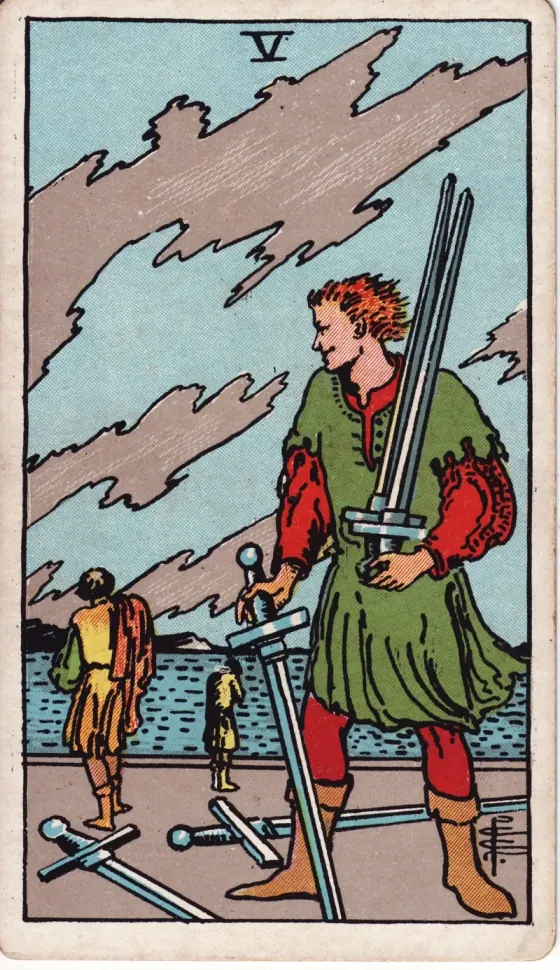 Five of Swords
Question: how did the negotiation end? I draw the Five of Swords. Swords: Air, conflict, words that cut. Five: trouble, a victory spoiled. And the Rider-Waite picture: a man gathers up swords, a smirk on his face, while two others walk away, beaten. I read it in one breath: I got my way, but by humiliating — there will be resentment left over. Another time, on another question, the same card would say something else entirely. That is free reading.