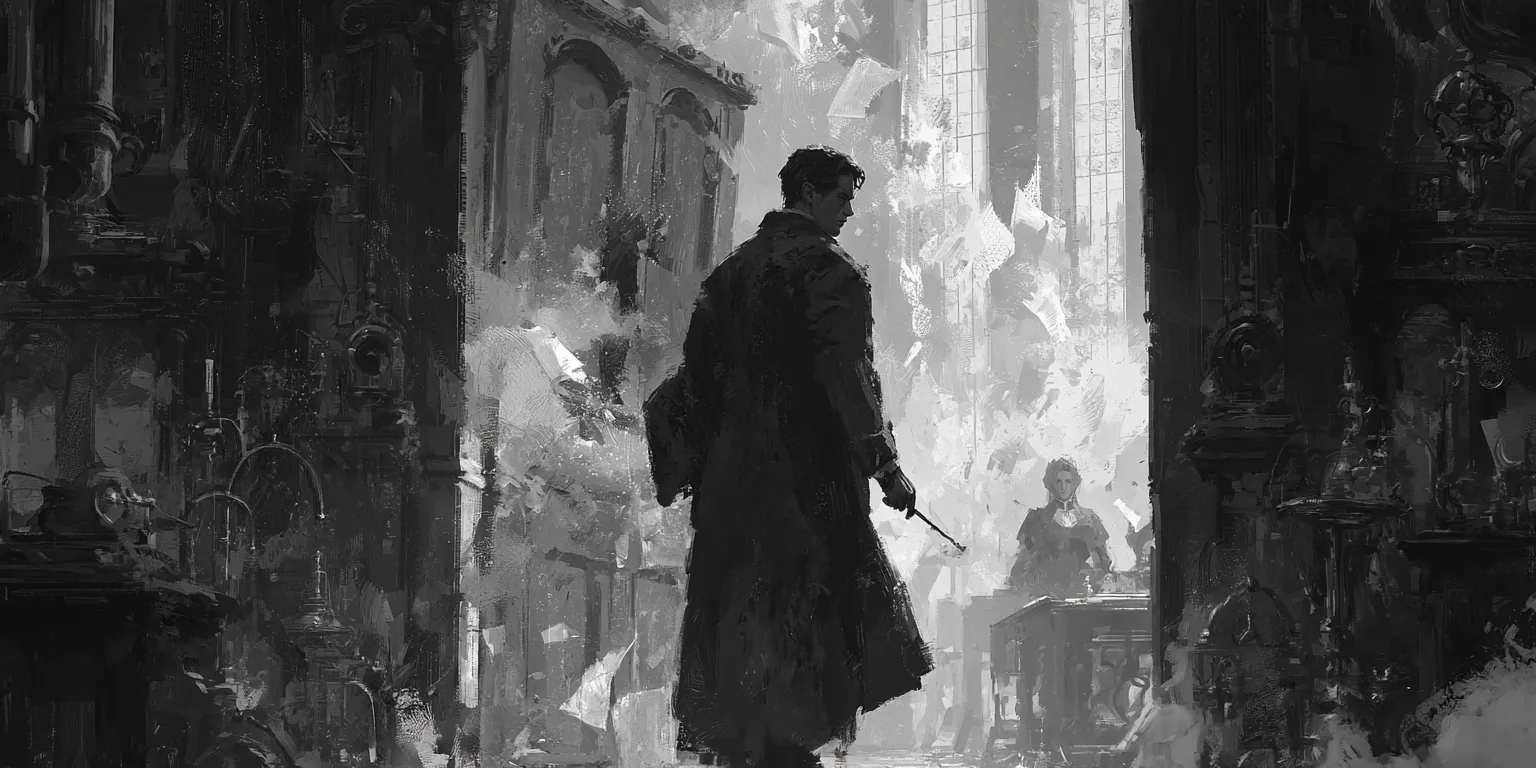
Who you are
knowing what he wants
I look at Alta and sneer. “You are nobody’s professor. An impostor. You make pacts with the kingdoms to preserve your little comfort. I will bring down your little assembly — your little world of luxury and idleness.”
Alta looks me over, then answers:
“I was waiting for that tirade, the one you have accustomed us to, Regiord. It seems to me that you are no longer part of this school. Leave this room, and let me finish my class. I am not saying goodbye.”
The door swings ajar. I throw her one last black look and go through it. Outside, I take out my rod, I cast a formula all my own, and it takes first time: the door slams behind me with a crash of thunder.
A character exists by two things: what he is, and what he does. A personality — who he is, what he wants — and a way of acting on the world. You are already playing, with an I sketched before you began and sharpened by everything you have put him through. This Chaptera stretch of adventure that rises, peaks and falls away. A convenience of storytelling: no mechanism depends on it, and it is most often recognized afterward.part 3 sets him down for good: where he comes from, how the elements live in him, what he wants underneath.
◆ Set down your character — in five minutes
Section titled “◆ Set down your character — in five minutes”- A name, and a sentence. Who is he, in one line: a trade, a bearing, a reputation. Not a file: a way in.
- A desire, in one sentence. What he wants or wants to learn, here, now: what will set him moving. Nothing to note in a box, nothing to keep up to date: it is enough that it pulls. He will change, he will forget it, another will take its place — and that is as it should be.
- One card — where you come from. Draw one card: it says your past, what made you, the wound or the impulse your desire is born from. One card only, read plainly — and there you are with a starting point.
- Two or three relations to the Suits (the four)Wands/Fire, what cannot wait · Cups/Water, what comes back · Swords/Air, the line that separates · Pentacles/Earth, what remains. They say a card’s matter, and how you acted.part 4. Say how each element lives in you, not what you know how to do but what it does to you. Does your desire (Fire) carry others along, or devour them? Is Water familiar to you, or foreign? A relation, never a meaning: you are not fixing what Fire means (that stays free), you are setting what it does when it falls. Two or three, never four: the elements left blank you will discover in play. Nothing is settled: a relation is rewritten the day the fiction has moved it (a desire, a break).
That is all — your character will draw himself by acting.
Example — Nera. Skyglider pilot, a skyfarer struck off from her sisterhood, accused of wrongs she denies. What she wants: to clear her name. Card drawn outside the Scenethe unit of play: you open it, you play it, you close it.part 3: the Five of Swords: a bitter victory, a conflict won at the cost of her own people. There is where she comes from: she was right, alone, and it cost her everybody. Her relations to the suits: Fire launches me, and I trust it — charging has never frightened me; Earth escapes me — anchoring myself, staying put, I always leave again. Two are enough; the rest will come.
Your character is set down for good. You already know how to play: to question, to act, to go through a Fatewhat comes in when you keep a major at the opening, and by no other door: the moment stops being ordinary. What it closes, only it can open.part 6, to make the world around him live; what you have just added is the suits and the past that will make each scene a little more yours. What remains is the play aid (appendix C), which keeps you from losing yourself playing alone.
You decide a great deal, in every scene; we come back to it in detail in part 12 (“Draw, or decide?”).
◆ Your character’s portrait
Section titled “◆ Your character’s portrait”The day you want to set him down for real, write his portrait: his name and a sentence for who he is, what he wants or wants to learn, the way two or three suits live in him, and what he carries, when what he carries says who he is.
Nothing else, and no count at all: the portrait holds only what says who he is. A defeat opens no box on it: fate changes the world, not a column (part 6).
What he carries, then, and not what he owns: a skyfarer’s case, a pendant that comes from someone, a radio you do not replace. Two or three things at most, never an inventory: nothing that is consumed, nothing you buy again on the corner. The test is in the page itself: if you hesitate to write it into the sentence that says who you are, it does not belong there. That is also what makes those things wagerable. Fate takes only what is written somewhere (part 6).
And it is not corrected, like any portrait (part 7): the day Fire no longer launches you as it used to, you are not going to cross out the line from six chapters ago: you write a fresh portrait, further on. The day fate takes one of your things, the same: you do not cross out the case, you write someone who no longer has it. That is how you see someone become other — not by a box altered, but by two portraits you read one after the other.
◆ What he wants — playing a desire
Section titled “◆ What he wants — playing a desire”Your character wants something. A place to reach, a truth to tear loose, a mastery, a revenge, someone to find again — or next to nothing, a tune he is trying to recover. Nothing here is a mechanism: no count to keep, no box to tick, no gesture reserved. What he wants is not played: it orients what you play, and that is already enormous: it is what makes you set one Wagerwhat fate can take, named in two clauses just before you resolve: what it takes, what happens if it does not take it. What you wager must belong on the standing page or the portrait.part 6 rather than another, and what gets you off the blank page on an evening when nothing comes.
If you do not know what he wants, draw a card outside the scene: it will tell you his desire, or the shape it takes. That draw is only a help. A desire belongs to no card, and Waitan open question that nobody else is looking into: it belongs to you, it ripens, it has the right never to close.part 8 for no card to move forward.
To write a desire is to make it losable. Kept in your head, it crosses scenes without ever risking anything: you put it off until tomorrow, you round it off, you tell yourself you are working on it. Noted in the notebook, beside your waits and your Stakean open question on which somebody else is making progress: it does not forget itself, and it does not ripen on its own.parts 8, 10, not as a count to tick but as a trace, it becomes a thing the world can close on you. One wants for a long time; the road is felt, it is not cut. And nothing obliges a desire to stay alone: the day you discover that one and the same knowledge serves two quests (learning the arcana of the somagma, finding the archmage Atalkt who holds them), the two roads become one, often knotted by a card drawn outside the scene without your having decided it.