The book stops explaining itself
Fifteen hundred words of gloss gone, five part openings rewritten to show the gesture, and three words retired from the lexicon.
The last devlog was about how the book looks. This one is about what it says — and mostly about what it no longer says. Both editions are 1,500 words shorter, and not one rule was dropped.
Three days of cutting. The parts that lost the most are the ones that had been explaining themselves twice: The Everyday (the)what plays out when you have kept a minor at the opening: fate has not come in, nothing is put at stake.part 4 is down 29%, Fatewhat comes in when you keep a major at the opening, and by no other door: the moment stops being ordinary. It resolves with the coin, never with cards, and what it closes, only it can open.part 6 18%, The Scenethe unit of play: you open it, you play it, you close it.part 3 20%. What went was gloss — the sentence after the sentence, the one that says again what the previous one had already said, a little flatter.
Openings that show the gesture instead of reciting it
Section titled “Openings that show the gesture instead of reciting it”Five part Opening (the)the gesture that begins every scene: three cards, you keep one, you give up the other two. The only draw where choosing costs, and the only door of fate.part 3 were rewritten. The old ones had a habit I stopped liking: they summarised the chapter in fiction. The everyday opened on a character listing, one by one, what the four Suits (the four)Wands/Fire, what cannot wait · Cups/Water, what comes back · Swords/Air, the line that separates · Pentacles/Earth, what remains. They say a card’s matter, and how you acted.part 4 mean — Fire that burns, Water that returns, Air that cuts, Earth that keeps. A reader arrived at the chapter having already been told everything, and the dialogue existed only to carry the lesson.
The new ones play a scene and let the chapter do its own work.
- The Cointhe oracle of closed questions: heads the first pole, tails the second. It is what resolves an action (part 5) and fate (part 6).part 1 now opens at the foot of the docks, two lanes that look alike, somebody following. The two Poles (the two)the two worlds you set down yourself before tossing the coin: never a yes and empty air. It is by them, too, that an action is resolved.parts 1, 5 are named before the toss — heads, left toward the lanterns; tails, right, into the dark — and it stops on “I toss it.” No result. The chapter is what teaches you to read it.
- The tarot opens on a card held, not drawn: the Fool, given by a mother at departure, dog-eared from riding against a chest. She read it as the one who sets out. Her child, today, sees a man walking at the edge of a drop with his eyes on the sky. Two readings of one card, before the rule that says exactly that.
- The everyday is now a third coffee on a terrace, a convoy date to check, a cat playing with a dragonfly. Nothing tips over. That is the whole point of the chapter.
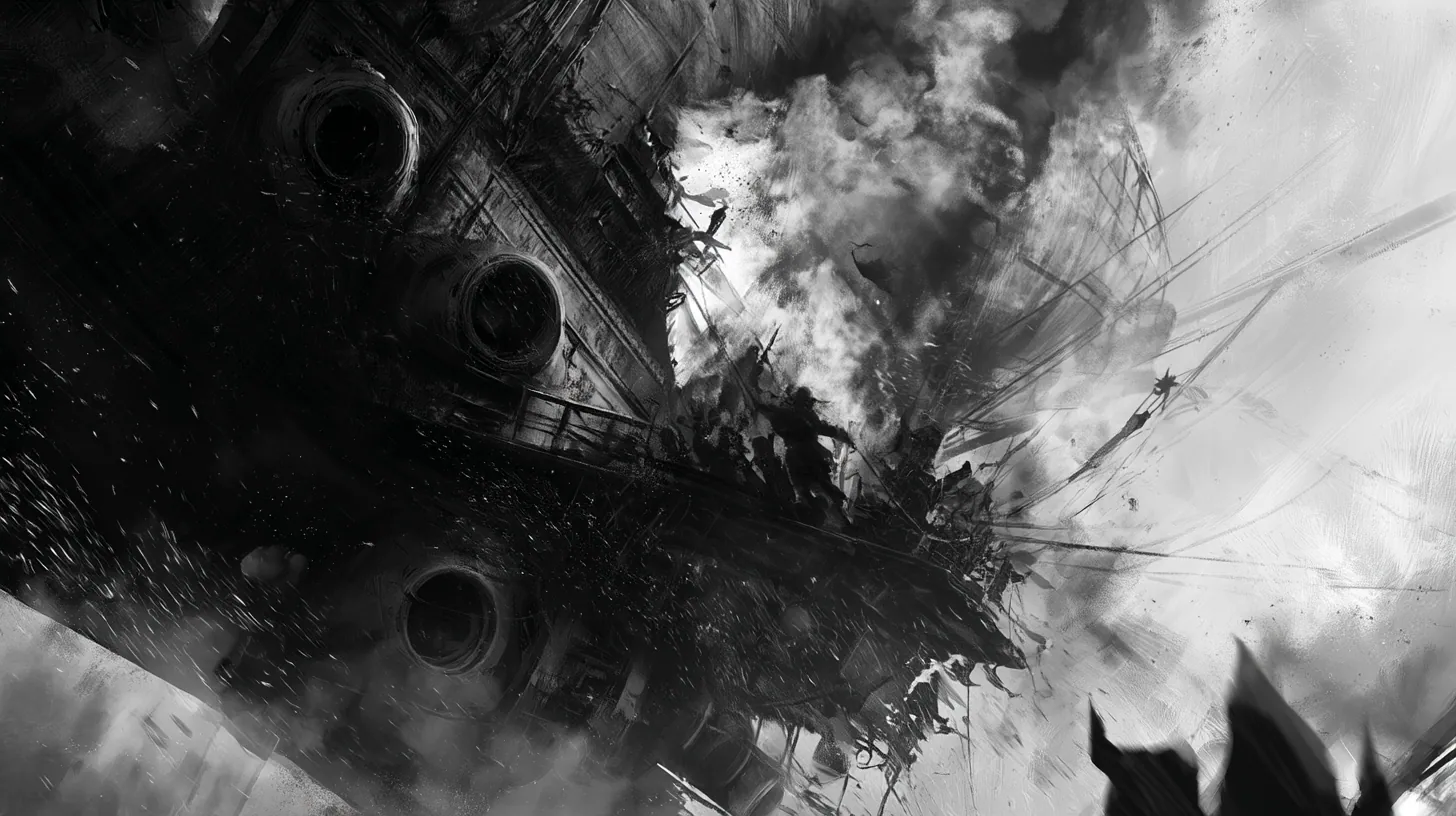
- Acting on the world finally matches its illustration — an armored barque coming apart in mid-air. It used to talk about a rope and a lookout.
Eighteen played scenes reworked, three new ones
Section titled “Eighteen played scenes reworked, three new ones”Nearly every worked example in the book was rewritten or re-framed. Three passages that merely described a rule are now scenes you watch: asking a place a question, drawing a card for a presence, probing an answer that already fell. Each one got what a scene here always gets — a heading, a place, an hour, and someone.
One example changed on a point of honesty. In Acting on the world, Nera wanted a skyglider; she tried to buy one, then to borrow one, and the third door — the one she was keeping so as not to think about it — used to be hiring on under a false name and waiting for the port of call where they would leave her alone at the helm. It is now hiring on openly, under someone else's orders. What the third loss would take from her is no longer “the right to get it cleanly”; it is the right to fly for herself. Same threat, truer to a skyfarer struck off her sisterhood.
The scene has four beats now, not three
Section titled “The scene has four beats now, not three”The gesture that begins every scene — three cards, keep one, let two go — was lodged inside framing, as if it were a formality of setting. It has its own beat: Open · Frame · Play · ↻ Close, and the chapter's four sections follow the four beats. The play aid already had “Open” in its loop; the chapter had drifted from it.
Three words left the book
Section titled “Three words left the book”A term that has to be defined twice is a term the book does not need.
- Recoil — the sentence where the body reacts before thought. It was a nice idea and it lived nowhere: every scene that needed it already wrote it.
- Push — an actor's Desirewhat your character wants. No mechanism, no count: it orients what you play.part 11. The actor's Portraitwhat you write about someone, actor or character: a name, what he wants, his suits, and what he carries when that says who he is. Without any count, and never corrected — you write a fresh one, further on.parts 7, 11 says “what he wants”, in plain words, and said it better.
- Seed — what you draw toward when you draw through to a Major Arcanumone of the twenty-two named cards, from The Fool to The World. It does not answer: it names, and it weighs.parts 2, 4, 6. The gesture is still there; it just says itself now.
Each one is marked dead in the translation glossary, with its English rendering retired, so no future pass can bring it back by accident.
Seven covers, and the last chapters that had none
Section titled “Seven covers, and the last chapters that had none”Every part of the book now opens on an image, and so do all six appendices. The one for The 78, card by card is the only one with nobody in it: a work Table (the)the surface in front of you: the cards drawn stay in view on it for the length of the scene.parts 2, 7, cards laid face up, candles lit. You consult a repertory, you do not read it.
Two of them broke the build before they worked, which is worth a line since this book is made by a pipeline. The play aid is also the A5 sheet you put beside your notebook — same source file — and its template had no idea what an illustration was: Typst stopped on unknown variable: illus and the sheet stopped being produced at all. It now ignores illustrations on purpose: the appendix carries its cover in the book and on the site, the sheet drops it, and it still fits on one double page. The colophon's cover, meanwhile, was being eaten by the very rule that strips the book's subtitle from the body — an image, it turns out, is a paragraph like any other.
- Asking a place a question got its own section in The world around, and the answer it gives is now played rather than summarised: no herbalist, a price.
- World or character? moved out of the tarot chapter and into Playing alone, merged into the section on when not to draw. It was the first filter of that decision, not a separate rule.
- Favorable and unfavorable draws moved the other way, into the tarot chapter, where reading a card belongs.
- The em dash count is down again — 4.7 per thousand words, against a ceiling of 8. The tool that measures it is in the repository; it caught me adding six of them in a single week.
What this does not change
Section titled “What this does not change”No mechanic moved. Nothing you have written in a notebook is invalidated, nothing needs re-learning. The book is shorter, its openings show more and tell less, and every part now has a picture at its head.
The whole thing is free to read online here, in both editions, and the PDFs on itch.io are already the new ones.
Ashcan edition: the book is complete and playable; it is not finished. Tell me what breaks.