What is pending
holding what is not finished
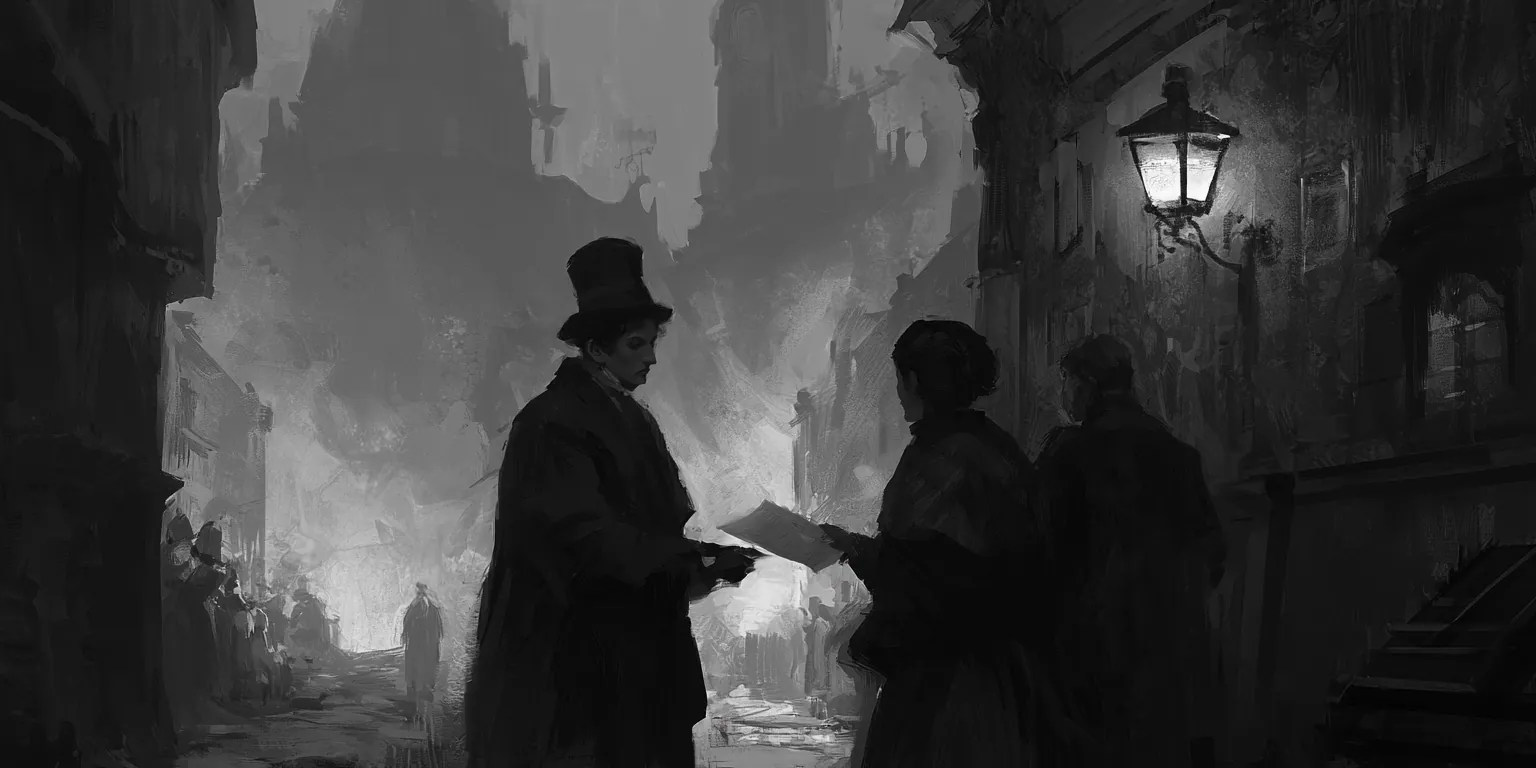
A letter passes from hand to hand, on a moonless night, on the docks of Fergris. The one who gives it does not raise his eyes; the one who takes it will not open it until she is aboard. Two quays away, Nera is asleep: she is to cast off in the morning.
A game does not hold together by what has happened: it holds by what is not finished. The people you have raised want things. Questions you have asked have no answer. And on some of them, somebody else is making progress while you look elsewhere.
Here is what stays open between two Scenethe unit of play: you open it, you play it, you close it.part 3: how you let it ripen, how you make it move on the day you can no longer bear not knowing, and how you write it so that it survives the page.
◆ Waits and stakes
Section titled “◆ Waits and stakes”A solo game does not move forward on its own: it needs something to follow. That something is the thread: the tension running from one scene to the next, what stays open when a scene closes and calls up the following one. It is not a mechanism; it is what gives a Chaptera stretch of adventure that rises, peaks and falls away. A convenience of storytelling: no mechanism depends on it, and it is most often recognized afterward.part 3 a direction instead of a run of draws with no memory.
It is made of everything that is pending: the Desirewhat your character wants. No mechanism, no count: it orients what you play.part 11 of the Actora presence that wants: someone who will come back and weigh, where the Backdrop is forgotten. You anchor him on the standing page in one line.part 7 on the standing page, a threat rising, and above all the waits and the stakes.
Not every question calls for an answer. Note them as they are: they are live gaps, and the world is working — more or less — underneath. What remains is knowing whether it is really working, and a single question says so: is somebody else looking for the answer?
If not, it is a wait. It belongs to you, it ripens at its own pace, it has the right never to close: why do I always leave, and what am I fleeing?
If so (a man you promised, a debt, a report you signed), it is a stake. Others are making progress on it while you look elsewhere, and it does not forget itself.
| The question | Is somebody else looking? |
|---|---|
| Astore’s barque, seen again in the distance after his death | No — it is mine alone: a wait |
| Why do I always leave, and what am I fleeing? | No — nobody digs at it in my place: a wait |
| Who commands Parilia, and why keep the parcel from its carrier? | Yes — someone is paying for me to know nothing: a stake |
| The debt promised before winter | Yes — he is counting the days: a stake |
And when you know something your character does not, set it aside as a meta note (“I am being followed — she does not know it yet”): it is often that which strings the story tight.
A wait, like a stake, is also what a draw turned inward comes to scratch at (part 2). The day you want to make it move, you open a lead on it: a scene declared for that (below). Two ways to play it: your character searches, or the world pushes it behind his back, in a World scenea declared scene in which your character is not present: the world advances behind his back. After three scenes played at his side the floor is the world’s; never two in a row, and fate does not come into it. It moves forward what pends, or it merely lives — a breather.part 9 (part 9). One lights, the other digs; often, you alternate.
◆ Creating a wait, played
Section titled “◆ Creating a wait, played”Regiord, on the deck of a great starship, early evening. Astore died months ago. I thought that circle was closed.
The sky is turning orange, the deck is quiet. I decide nothing. I ask. Is something happening, far off? — coin: heads, yes.
Off to port, right at the horizon, a glint catches the last of the sun. Something, yes.
A barque? — coin: heads, yes. I take out the spyglass.
I turn the focus wheel. A small hull, alone, running quietly toward the horizon.
And there, without asking the coin anything, the idea falls on me, too strong for me to refuse it: that outline, I know it. The line of the hull, the gash on the fin. It is Astore’s barque. In every detail. No toss told me so; it came on its own, and that is what makes the moment burn, so it is true, and I keep it. Fun is the engine: an idea like that, you seize it, you do not put it to the vote.
She is heading for the same place as always. As though he had never come down from her.
My thumb finds the coin all the same. Is he at the helm, alive, come back? One toss, and I would know: heads he is there; tails his barque without him, sold, stolen, drifting alone.
And I do not toss.
That one does not want an answer. It is worth more open than closed. If I settle it, I have a fact, and the fact kills the unease. If I leave it, I have a live gap: something the world will keep digging at beneath the surface, without my knowing. A man like that, dead, and his barque still running toward his destination… no. I do not want to know. Not now. Perhaps never. I close the spyglass and I note it in the notebook, without answering it:
Wait: Astore’s barque, seen again in the distance, after his death. So his route was not finished?
The world works underneath. It will tell me when it wants to — or never. That is quite all right.
◆ What is left open
Section titled “◆ What is left open”A scene closes badly when it closes on nothing. Before you turn the page, ask: what is left open? Three kinds of thing come out of it, and you do not keep as much of each.
The bridging question: one only, and it does not go to the standing page. Where am I going to wake up? It does not pend: the next scene answers it, and it is even what frames that scene. It is the question you will put at your next Opening (the)the gesture that begins every scene: three cards, you keep one, you give up the other two. The only draw where choosing costs, and the only door of fate.part 3. Do not write it down: it will not survive until tomorrow, and that is what is asked of it.
Waits and stakes: what really pends. Who is the Mender? What is this business of Fatewhat comes in when you keep a major at the opening, and by no other door: the moment stops being ordinary. What it closes, only it can open.part 6 on the three skyfarers? They go to the standing page, and they gain by ripening.
And all the rest, which you let die. That is the important part. A scene raises ten things; if you note them all, your standing page becomes a shopping list and nothing on it weighs any more. Choose what you carry away: what you do not note has not existed. A question you do not feel like writing down was not one.
This is not a review round. A dense scene sets down two or three: write them in one go, without counting. The limit is not on the number, it is on where they come from: only what this scene has just produced. Do not reopen the standing page at this moment to choose which thread to advance: that is taking inventory, and the standing page becomes a menu. Here you do not reread. You look at what the scene has just left behind it. Rereading it has its moment, and this is not the one: it is when you close a session (part 10).
◆ Opening a lead
Section titled “◆ Opening a lead”A wait demands nothing: it can live ten chapters on the standing page and never close: that is its natural state. And it gains by waiting. The world works underneath, and that is not just an image: every chapter played without touching it lays down around it matter that had not come for it: a name, a coincidence, a face. The day you open its lead, your draw will fall into a field already sown, and the answer will almost assemble itself. A stake, for its part, does not ripen on its own: it is no longer the chance of chapters laying things down around it, it is somebody making progress.
But a day comes when you can no longer bear not knowing. Then, before framing your next scene, declare it: this one will look for the answer. That is all “opening a lead” means: not a separate draw, not a new rule. You open, frame and read as always; only the intention changes. Your character searches, and it is in playing that he finds. Nothing obliges him to search himself, moreover: the same lead can also be pushed in a world scene, behind his back (part 9).
One scene is sometimes enough. If not, declare another with the same aim, as many as it takes. But you do end up deciding: when a scene touches the answer (or leaves you only one last silence, a face that knows and will not say), write it in one line; the question will not pass to the next standing page. Resolving is not finishing: an answer often uncovers others; note behind it the new question, if one is born.
◆ A lead, played
Section titled “◆ A lead, played”A question has been sleeping on Nera’s standing page since the North Gate: who handed the parcel to Parilia — and did he know what it carried? Tonight I stop letting it sleep: I make a scene of it.
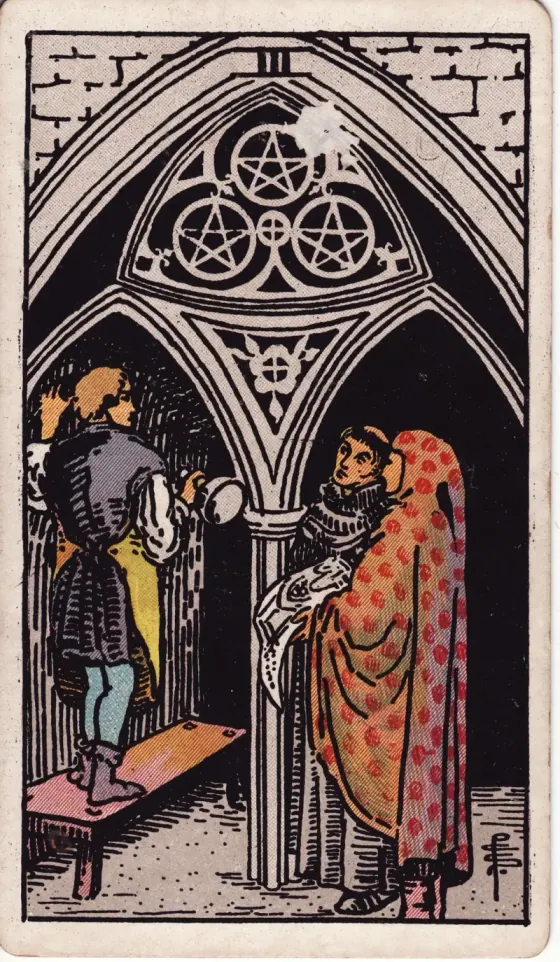
I do not read a card in Nera’s place — I send her digging. I open on a draw and I keep the Three of Pentacles. Earth, several hands, a commissioned work: writings, registers, an object passed from one to another. This is not the answer: it is the ground of the search. Nera does not charge at a revelation; she goes looking where things are recorded. A number, not a court card: the search can turn up something, not only someone.
 kept
kept
 left
left
 left
left
The freight office of the upper port smells of wax and old paper. I set down before the clerk the only name I have. “The cargo they had me carry south, last month. I want to know where it starts from.” He sighs, pulls out a register, follows the lines with his finger. “Order placed, parcel handed over, carrier assigned.” Three entries, three hands — just as the card announced.
And there, it happens.
I read over his shoulder. The parcel did not begin at Parilia’s: she is only a line in the middle. Above her, another hand ordered the shipment and paid in advance, and in the margin, an instruction I make out upside down: “carrier not to be informed of the contents.”
I close the register without a word. The clerk has not seen what he has just shown me. I have.
This time it is Nera who knows — not only me. She read the line, she leaves changed. The question closes; I write the answer; on the next standing page, the question will not be there:
Answer: the parcel comes from a commissioner above Parilia, paid in advance, with orders to keep the carrier in ignorance. I am the last link, chosen to know nothing.
A court card would have given me a face rather than a written line: someone to make talk, probably one more scene. Here, a number: the search gives back a thing, and the thing is enough. One scene closed that lead; sometimes it takes two or three — you declare again, you play again, until you decide.
But arriving is not finishing. In closing the old question, the answer uncovers a new one: that name above Parilia, who is it? I do not move the old one, it is closed for good; this one was born of what I have just learned. I note it beside the other, struck out:
Stake: who commands Parilia — and why keep the parcel from its carrier?
A lead that closes does not close a story; it moves it forward by a notch. That is all that is asked of it.
◆ The author’s hand — questioning the story between scenes
Section titled “◆ The author’s hand — questioning the story between scenes”Minor Arcanumone of the fifty-six cards of the four suits, from Ace to King: the matter of the everyday.parts 2, 4 answer you too, not only your character. Between two scenes, when you want to know where a plot is going, what a faction is scheming, what is waiting in the next chapter: put an open player’s question and draw. It is no longer your hero perceiving: it is you sounding your own story, like a game master consulting the oracle before preparing what comes next.
Here, outside the played fiction, you can draw several cards and read their progression: the order of the elements (Fire giving way to Water, Earth climbing toward Air), the rise or fall of the numbers, a symbol that returns. These richer readings, which would weigh too much inside a scene, find their place here: you are not playing, you are building. Note what comes out of it on the standing page, like a thread you will know to be true before your character does.
◆ The standing page — the page that keeps what is pending
Section titled “◆ The standing page — the page that keeps what is pending”Everything pending has to survive the scene that gave rise to it, and the one after. That is the work of a single page.
◆ Keeping your notebook
Section titled “◆ Keeping your notebook”Everything is written in the same place: the scenes, and what has to survive them. There is no reserved page, nothing to prepare before starting: a blank notebook is enough. Only two things are written otherwise than the play: the standing page, and the Portraitwhat you write about someone, actor or character: a name, what he wants, his suits, and what he carries when that says who he is. Without any count, and never corrected — you write a fresh one, further on.parts 7, 11.
Mark their page: a colored corner, a tab, as you like. One rule only: a marked page contains nothing else. Open a fresh one to write, another to come back to the play; the paper wasted will cost you less than the page you cannot find again.
◆ What lives on it
Section titled “◆ What lives on it”The standing page says what, at this hour, is still waiting for something from you: the living actors, one line each (that they exist, what they want, what you do not know about them); the waits and the stakes, the latter marked as such; the desires under way, with the trace of the road (door closed, side route, condition burned) and never a count of scenes; and what fate has closed, one line per door, the only trace that says it will take a Major Arcanumone of the twenty-two named cards, from The Fool to The World. It does not answer: it names, and it weighs.parts 2, 4, 6 to open it again (part 6).
There is only one at a time, and it replaces the previous one. The day yours no longer reads (too many crossings-out, too many dead things), write it anew, further on in the notebook. Copy across what is still alive. The rest, you do not cross out: you do not copy it, and it is finished. A question that no longer intrigues you dies out there, without ceremony; an actor you no longer play fades of his own accord. That is not a failure, it is information.
Never rewrite it by calendar: it is rewritten when the paper demands it, not when the clock says so.
◆ A portrait, in progress
Section titled “◆ A portrait, in progress”This is not a scene: it is the page. Parilia’s portrait as it reads on Nera’s standing page, after three chapters. An actor who has moved twice without a single line being crossed out.
Parilia. Push: to know before the others, to hold by the secret. Keywords: patient, never head-on, ticks lines on lists nobody sees. Open question: why me?
Bonds. At the start — she seems to expect nothing from me but a parcel delivered. · Since the North Gate — she seems to have chosen me for something other than the parcel. · Since Sybia named her before the sisterhood — she seems to have more to lose than I do.
Meta note — she does not hate me: she is afraid of what I might know. (Nera does not know this.)
Three bonds stacked, none corrected: that is how you see someone shift — not by one line rewritten, but by three you read one after the other.
→ Portrait → part 11 · The gesture and the Decka single pack of 78 cards, majors and minors mixed, reshuffled at the opening of every scene.part 2 that remembers → part 2